Telescopes

Telescope, device used to form magnified images of distant objects. The telescope is undoubtedly the most important investigative tool in astronomy. It provides a means of collecting and analyzing radiation from celestial objects, even those in the far reaches of the universe.
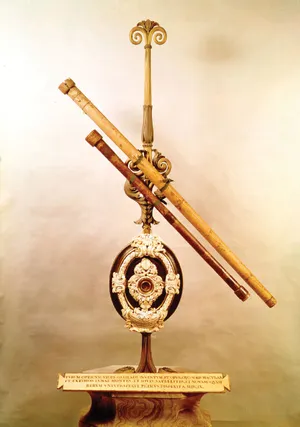
Galileo revolutionized astronomy when he applied the telescope to the study of extraterrestrial bodies in the early 17th century. Until then, magnification instruments had never been used for this purpose. Since Galileo’s pioneering work, increasingly more powerful optical telescopes have been developed, as has a wide array of instruments capable of detecting and measuring radiation in every region of the electromagnetic spectrum. Observational capability has been further enhanced by the invention of various kinds of auxiliary instruments (e.g., the camera, spectrograph, and charge-coupled device) and by the use of electronic computers, rockets, and spacecraft in conjunction with telescope systems. These developments have contributed dramatically to advances in scientific knowledge about the solar system, the Milky Way Galaxy, and the universe as a whole. This article describes the operating principles and historical development of optical telescopes. For explanation of instruments that operate in other portions of the electromagnetic spectrum, see radio telescope; X-ray telescope; and gamma-ray telescope.

Refracting telescopes

A refracting telescope is an optical instrument that uses lenses to gather and focus light, forming a magnified image of distant objects. It consists of a large convex objective lens that collects light and bends (refracts) it to a focal point, where a smaller eyepiece lens magnifies the image for viewing. First developed in the early 17th century, this type of telescope was famously used by Galileo for astronomical observations. Refracting telescopes offer sharp, high-contrast images and are relatively simple in design, with a sealed tube that protects the optics from dust and moisture. However, they also have limitations, such as chromatic aberration, where different wavelengths of light bend at slightly different angles, causing color distortion. Additionally, they tend to be heavy and expensive because large lenses are difficult to manufacture without defects. Despite these challenges, refracting telescopes are still widely used for celestial observations, terrestrial viewing, and scientific research.
Reflecting telescopes

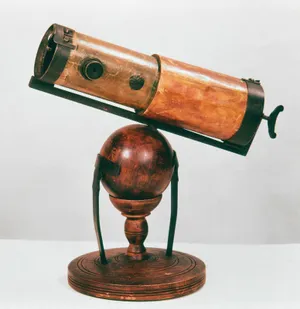
Another major type is the reflecting telescope, which uses mirrors instead of lenses to collect and focus light. Invented by Isaac Newton, this design features a concave primary mirror that gathers light and reflects it to a secondary mirror or directly to an eyepiece. Unlike refractors, reflecting telescopes do not suffer from chromatic aberration since mirrors reflect all wavelengths of light equally. They are also more cost-effective and lightweight compared to large refracting telescopes, making them ideal for modern astronomical observatories. Another advanced type is the catadioptric telescope, which combines lenses and mirrors to improve optical performance. Popular designs like the Schmidt-Cassegrain and Maksutov-Cassegrain telescopes are compact, versatile, and widely used in astrophotography. These telescopes offer the advantages of both refracting and reflecting systems, making them suitable for professional and amateur astronomers alike.
The Schmidt telescope
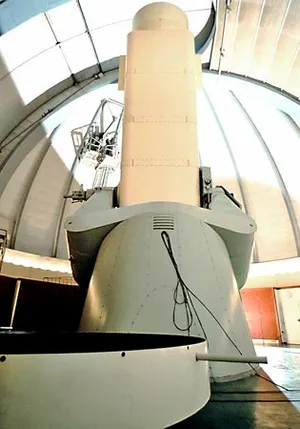
The Ritchey-Chrétien design has a good field of view of about 1°. For some astronomical applications, however, photographing larger areas of the sky is mandatory. In 1930 Bernhard Schmidt, an optician at the Hamburg Observatory in Bergedorf, Germany, designed a catadioptric telescope that satisfied the requirement of photographing larger celestial areas. A catadioptric telescope design incorporates the best features of both the refractor and the reflector—i.e., it has both reflective and refractive optics. The Schmidt telescope has a spherically shaped primary mirror. Since parallel light rays that are reflected by the centre of a spherical mirror are focused farther away than those reflected from the outer regions, Schmidt introduced a thin lens (called the correcting plate) at the radius of curvature of the primary mirror. Since this correcting plate is very thin, it introduces little chromatic aberration. The resulting focal plane has a field of view several degrees in diameter. The diagram illustrates a typical Schmidt design.

Multimirror telescopes

The main reason astronomers build larger telescopes is to increase light-gathering power so that they can see deeper into the universe. Unfortunately, the cost of constructing larger single-mirror telescopes increases rapidly—approximately with the cube of the diameter of the aperture. Thus, in order to achieve the goal of increasing light-gathering power while keeping costs down, it has become necessary to explore new, more economical and nontraditional telescope designs.
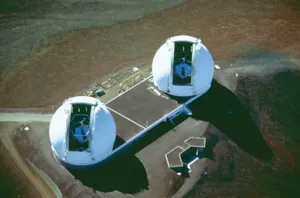
The two 10-metre (33-foot) Keck Observatory multimirror telescopes represent such an effort. The first was installed on Mauna Kea on the island of Hawaii in 1992, and a second telescope was completed in 1996. Each of the Keck telescopes comprises 36 contiguous adjustable mirror segments, all under computer control. Even-larger multimirror instruments are currently being planned by American and European astronomers.
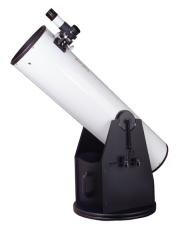
SAXON DOBSONIANS 6″ Dobsonian $390AUD 8″ Dobsonian $590AUD 10″ Dobsonian $860AUD 12″ Dobsonian $1390AUD – COLLAPSIBLE 8″ DOBSONIAN $560AUD – COLLAPSIBLE 10″ DOBSONIAN $860AUD – COLLAPSIBLE 12″ DOBSONIAN $1585AUD
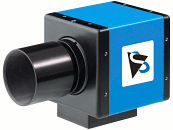
Best Camera For Price The Imaging Source DMK21AF04.AS USB Camera inc. 1.25″ Adaptor, USB Cable Planetary & Moon Astrophotography $445AUD
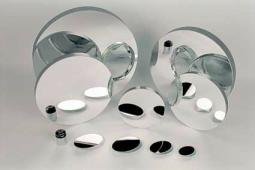
16″ Mirror F/:4.5 Coated Optics Around 1/8 wave B270 Glass 45mm Thick Hand Corrrecting with new Overcoatings Service Available $1100AUD
AutoStar Computer Goto 120,000 Objects Firmware Updates Suits GP, GP/DX, EQ5, LXD55, CG5 Mounts $600AUD
Scroll to Top